What is an EICR — and do you actually need one in Bournemouth?
A plain-English guide to the Electrical Installation Condition Report: who it's for, what gets checked, what the codes mean, and roughly what you should expect to pay along the south coast.
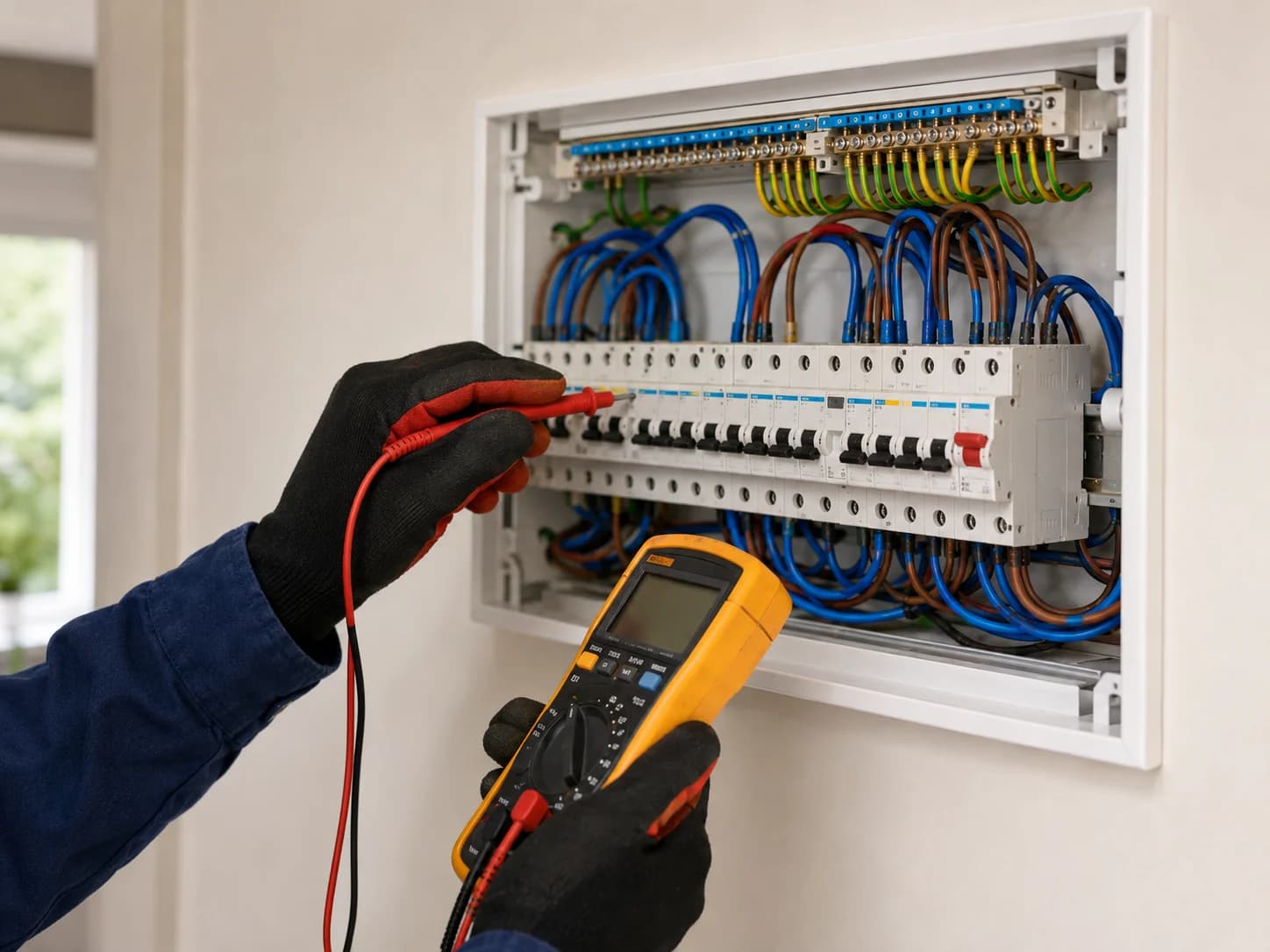
If you own, let or run a property in Bournemouth, sooner or later the phrase “EICR” will land on your desk — usually from a managing agent, a buyer's solicitor, or your insurer. It sounds bureaucratic. It isn't. An EICR is the closest thing you have to a structural survey for the electrics behind your walls, and getting one wrong can mean fines, voided cover, or a fire that didn't have to happen.
This guide walks through what an Electrical Installation Condition Report actually is, who legally needs one, what we look for during the inspection, how to read the result, and what a fair price looks like in Dorset right now.
§ 01 · The basicsWhat is an EICR?
An Electrical Installation Condition Report — EICR for short — is a formal inspection of the fixed wiring in a building. That means everything from the consumer unit (your fuse board) through to the sockets, switches, lighting circuits, isolators and earthing. Portable appliances aren't part of the test; that's PAT testing, which is a separate thing.
The report is produced against the current edition of BS 7671, the UK wiring regulations, and is signed off by a competent electrician registered with a scheme like NICEIC, NAPIT or ECA. You get back a multi-page document grading every observed defect, plus an overall verdict of Satisfactory or Unsatisfactory.
In one line
An EICR tells you whether the electrics in a property are safe to keep using, what needs fixing now, and what should be improved before the next inspection.
The MOT Analogy: How an EICR Relates to a Car Test
One of the easiest ways to understand an EICR is to think of it like an MOT for your building’s electrical system.
An MOT does not guarantee that your car will never break down. It simply confirms that key safety parts, such as the brakes, tyres and seatbelts, meet the required standard at the time of the test. An EICR works in a similar way. It checks whether your wiring, earthing, bonding and RCD protection are safe and functioning as they should be at the time of inspection.
If a car receives a major MOT failure, it is considered unsafe to drive until the issue is fixed. With an EICR, a C1 defect means there is immediate danger, while a C2 defect means there is potential danger. Either of these will result in an Unsatisfactory report, and remedial work will be needed before the installation can be signed off as safe.
An MOT can also include advisories, such as brake pads that are wearing down but are not yet dangerous. This is similar to a C3 observation on an EICR. A C3 means improvement is recommended, but it does not cause the inspection to fail. Your report can still be marked as Satisfactory, although the electrician may highlight upgrades worth considering to improve safety and bring the installation closer to modern standards.
§ 02 · Legal dutyWho needs one, and how often?
Whether you legally must have one depends on what you do with the property:
Private rented housing
Since April 2021, landlords in England must hold a valid EICR for every let property, renewed at least every 5 years (or sooner if the report says so). A copy must be given to tenants within 28 days and to the local council on request. Bournemouth, Christchurch & Poole Council can issue penalties of up to £30,000 for non-compliance.
HMOs (Houses in Multiple Occupation)
HMOs have required 5-year EICRs since 2006. If you operate one and don't have a recent certificate, treat it as urgent.
Commercial & workplace properties
Frequency is risk-based under the Electricity at Work Regulations 1989. As a rule of thumb: offices and shops every 5 years; industrial units every 3; construction sites annually.
Owner-occupied homes
Not a legal requirement — but strongly recommended every 10 years, or whenever you buy a property, take on an older home, or notice anything odd (warm sockets, breakers tripping, scorch marks, lights dimming when the kettle goes on).
Heads up — selling soon?
If you're listing a property in BH1–BH25 this year, a recent satisfactory EICR is one of the cheapest ways to defuse buyer concerns before they reach a survey. Expect it to come up.
§ 03 · The inspectionWhat actually gets checked
An EICR is part visual, part instrumented. On a typical three-bed semi we'll spend two to three hours on site doing some combination of:
- Visual condition of the consumer unit, accessible sockets, switches, light fittings, isolators and the meter tails.
- Continuity testing of protective conductors (earth bonding) and ring final circuits.
- Insulation resistance between live conductors and earth.
- Polarity checks at every accessible point.
- Earth fault loop impedance — how quickly a fault would clear.
- RCD/RCBO operation, including trip time and current sensitivity.
- Identification of departures from BS 7671 — e.g. lack of RCD protection on circuits feeding outdoor sockets, missing main protective bonding, undersized cables.
§ 04 · The resultUnderstanding the codes (C1, C2, C3, FI)
This is the part of the report most people get stuck on. Every observation we make is classified with one of four codes. They are what decide whether the report comes back Satisfactory or Unsatisfactory.
If you receive an Unsatisfactory report, don't panic. The remedial work is usually targeted — swapping a fuse board, adding RCBOs, running a bonding cable — and a re-test usually isn't needed for C2/C3 items once the work is signed off with a Minor Works or Electrical Installation Certificate.
Need an EICR in BH?
Fixed-price reports across Bournemouth, Christchurch & Poole. NAPIT certified, fully insured, weekend slots available.
§ 05 · Time & costHow long does it take? What does it cost?
For a domestic property in the Bournemouth area, ballpark figures look like this:
- 1-bed flat — 1.5–2 hours on site, £120–160 +VAT
- 2/3-bed house — 2.5–3 hours, £180–240 +VAT
- 4/5-bed house — 3.5–4 hours, £260–340 +VAT
- Small commercial unit — from £320 +VAT, quoted on inspection
Prices vary by circuit count and accessibility. If your consumer unit is buried behind a fitted wardrobe, allow more time. Most clients receive the signed report by email within 48 hours of the visit.
§ 06 · On the dayHow to prepare
You don't need to do much, but a few small things make the day faster (and the report cheaper):
- Clear access to the consumer unit, meter, and any outdoor isolators.
- Let tenants know the power will be off for short windows — usually 15–40 minutes per circuit.
- Unplug anything sensitive: desktop PCs, NAS, aquarium pumps, freezers if you can.
- If you have previous certificates or installation drawings, dig them out. They speed up everything.
§ 07 · Next stepsBooking your inspection
If you want a fixed-price quote for a property anywhere in the BH postcode area, we'll typically come back to you the same day with a visit slot within the week — sooner for urgent compliance situations.
We're a small team, so the person who quotes the job is usually the person who does it. No subcontractors, no surprises on invoice. Every report we issue is fully certified, legally compliant, and backed by our standard professional guarantee.
Frequently asked
Quick answers
How long does an EICR certificate last?+
Will my power be off for the whole inspection?+
What happens if the report is Unsatisfactory?+
Do I legally have to use an NICEIC contractor?+
Can you do EICRs outside of normal working hours?+
What area do you cover?+
Keep reading
Related from the Journal
The 2026 Guide to Landlord Electrical Safety in Bournemouth, Poole & Christchurch
Landlord Compliance Guide 2026: Navigate the Renters' Rights Act 2025, National Property Portal, and your EICR obligations in the BCP area.
How Much Does a House Rewire Cost in Bournemouth?
Discover the true cost of a house rewire in Bournemouth for 2026. SC Electric breaks down the prices, hidden factors, and compliance standards.